Brake system of the Audi TT MK1 (8N)
Braking system with 4-channel ABS, EBV, EDS and ASR for optimal active safety.
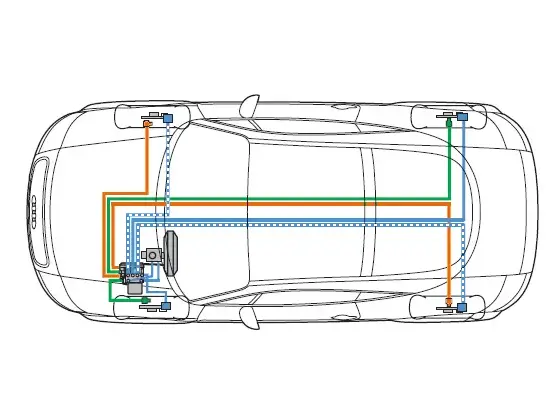
The TT has a dual-circuit braking system, an ABS anti-lock braking system divided diagonally with electronic distribution of the braking force EBV.
Electronic brake force distribution (EBV) regulates the brake pressure at the rear wheels via the ABS control unit in order to avoid excessive braking.
The EBV regulation is cancelled by the entry into play of ABS regulation.
The electronic differential lock (EDS) provides assistance when starting on a slippery road.
Spinning wheels are automatically braked and drive torque is transferred to the wheel with grip.
The traction control system (ASR) prevents by reducing the engine torque at acceleration that the driving wheels do not skate. This effect is achieved by shifting the ignition point and sporadically cutting the injectors.
Anti-lock system – ABS - ITT/Mark 20 IE
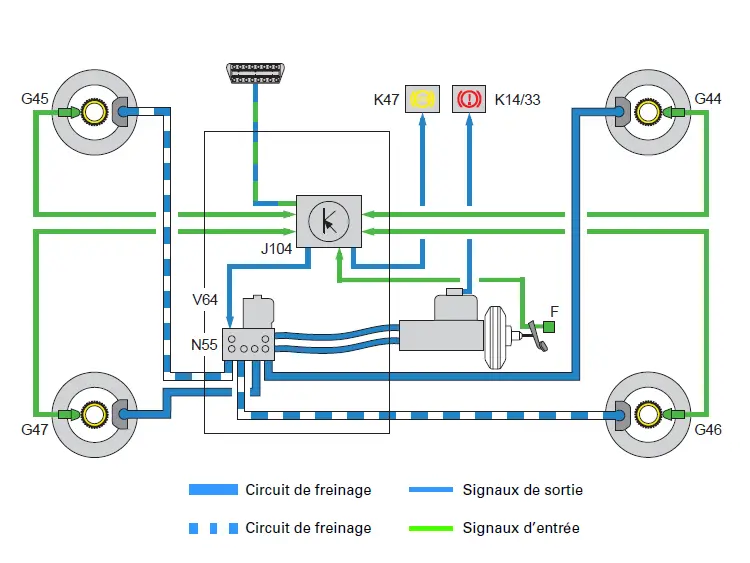
The basis of the ABS system is a dual-circuit braking system. The arrangement of the braking circuits is diagonal; they feed the front left and rear right wheels and respectively the front right and rear left wheels.
Each wheel has its own brake line from the hydraulic unit’s 4-channel system.
The EBV electronic brake force distribution system is fully software-based. You don’t need any hardware.
A fault detection in the ABS system is indicated by visual contact and self-diagnosis (diagnostic equipment).
ESP system - ITT-Automotive
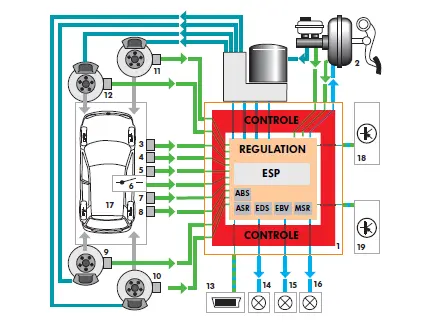
| Number | Description |
|---|---|
| 1 | Hydraulic unit with J104 : ABS control unit with EDS/ASR/ESP |
| 2 | Active brake servo with master cylinder and brake pressure sensor |
| 3 | G249 : Longitudinal acceleration sensor (Quattro/Syncro only) |
| 4 | G200 : Lateral acceleration sensor |
| 5 | G202 : Yaw rate sensor |
| 6 | E256 : ASR/ESP button |
| 7 | G85 : Steering angle sensor |
| 8 | F : Brake light switch |
| 9 to 12 | G44, G45, G46 and G47 : Speed sensors |
| 13 | Diagnostic Cable |
| 14 | K118 : Brake indicator |
| 15 | K47 : ABS warning light |
| 16 | K155 : ASR/ESP warning light |
| 17 | Vehicle and driver behaviour |
| 18 | Intervention in engine management |
| 19 | Intervention in transmission management (automatic transmission only) |
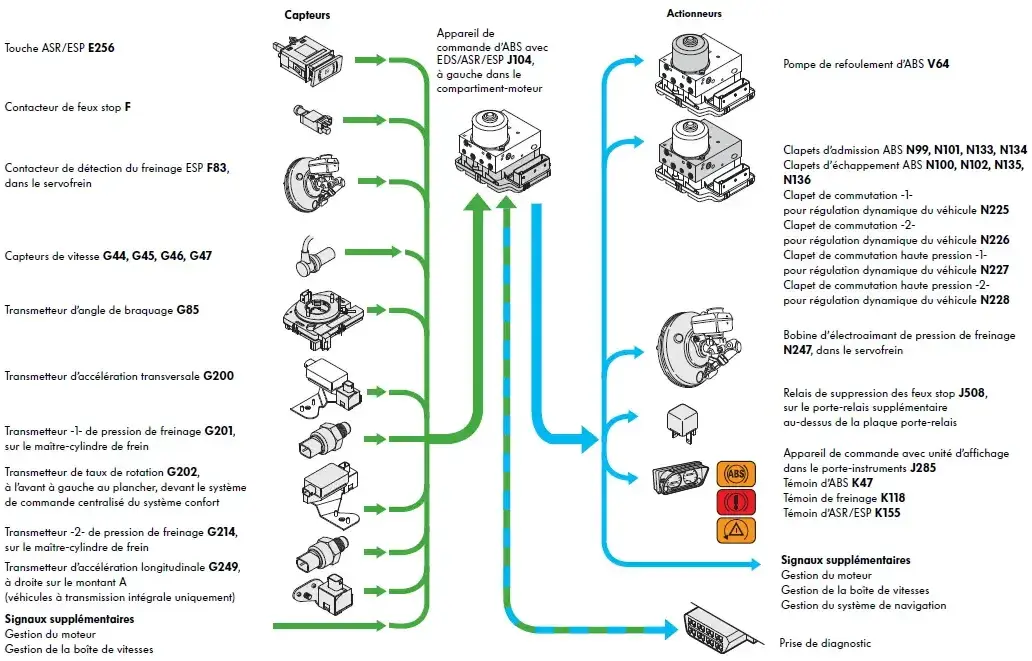
The speed sensors continuously provide the speed of rotation for each wheel. The steering angle sensor is the only sensor that transmits its data directly to the controller via the CAN bus. The control unit calculates, from the two information, the steering direction assigned and the road behavior assigned of the vehicle.
The transverse acceleration sensor signals to the control unit a lateral flush, the rotation rate sensor a tendency to skid the vehicle. The control unit calculates the actual state of the vehicle from these two information.
If the assigned and actual values differ, a control intervention is calculated.
The ESP decides:
- which wheel must be braked or accelerated and the force to be applied,
- if it is necessary to reduce the motor torque and
- whether to operate the transmission control unit on vehicles with an automatic gearbox.
The system then checks, in support of the data delivered by the sensors if the intervention has been successful: If yes, the intervention is complete and the vehicle behaviour continues to be observed.
If not, there is a new activation of the control circuit.The flashing ESP warning light tells the driver that the system is intervening.
On all-wheel drive vehicles, a longitudinal acceleration transmitter completes the control circuit.
The role of the vehicle's hydraulic dynamic control pump is provided here by the brake booster using the brake pressure electromagnet coil and a brake detection contactor in the brake booster.
The regulation process has already been described: If the assigned and actual values differ, a regulation intervention is calculated until the sensor information indicates that the vehicle has regained its stability.
Functions of components
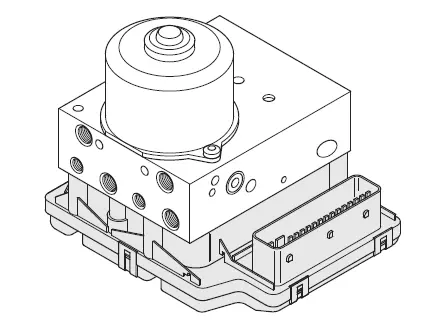
J104 - ABS control unit with EDS/ASR/ESP
It continuously monitors all electrical components and helps with diagnostics during workshop maintenance.
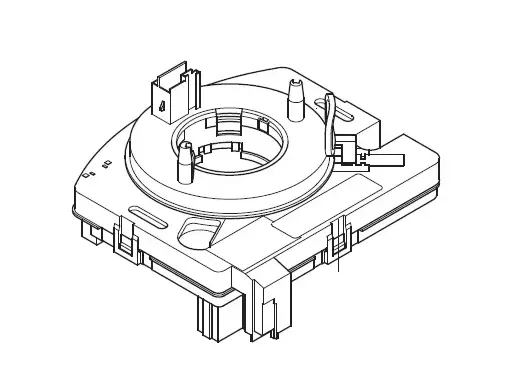
G85 - Steering angle sensor
It sends the left or right steering wheel angle to the ABS control unit with ASR/ESP. An angle of ±720° is measured, equivalent to four complete turns of the steering wheel.
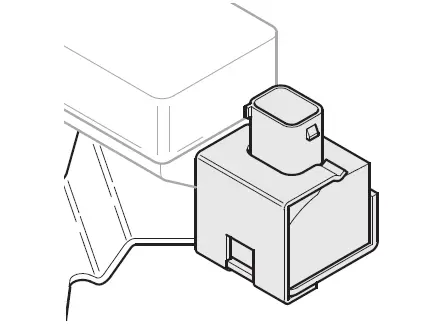
G200 - Lateral acceleration sensor
It determines whether transverse forces are attempting to deflect the vehicle from its intended course and, if so, with what intensity.
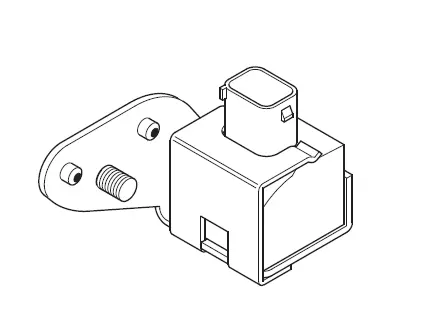
G249 - Longitudinal acceleration sensor
Present only on quattros. It allows to validate the theoretical calculation of the vehicle speed determined from the individual speed sensors of each wheel.
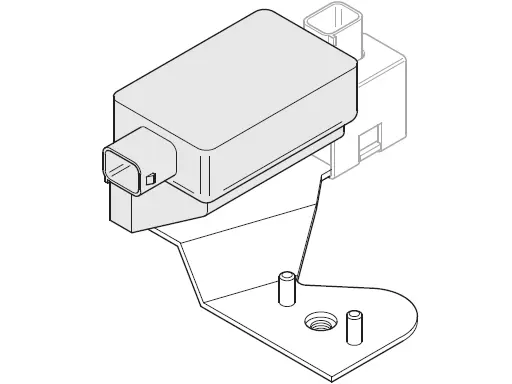
G202 - Yaw rate sensor
It determines whether the vehicle rotates around its vertical axis.
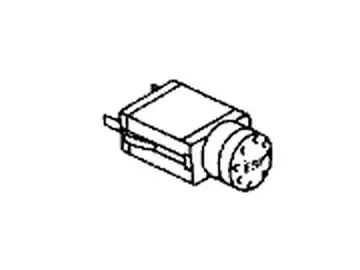
E256 - ASR/ESP button
It allows the driver to switch off the ESP operation
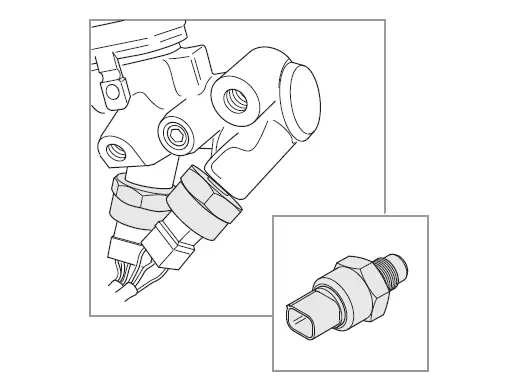
G201 and G214 - Brake pressure transmitter 1 and 2
For safety reasons, there are two brake pressure transmitters. It indicates to the control unit the pressure in the braking circuit.
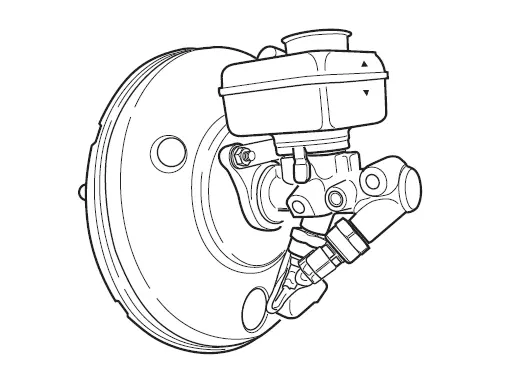
Active brake servo with tandem brake master cylinder
It amplifies the braking force exerted on the brake pedal and also generates a pre-pressure (10 bar) for ESP intervention.
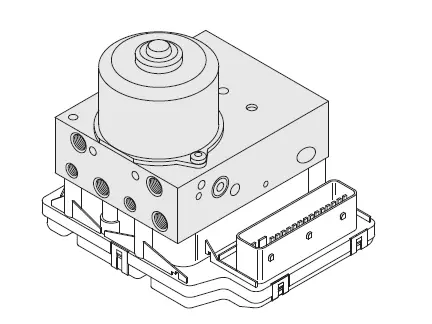
Hydraulic unit
The hydraulic unit operates with two braking circuits arranged diagonally. The switching and high pressure valves are located there.
Synoptic of the system