Audi TT MK1 (8N) turbocharging
Electronic turbo control, wastegate, twin intercoolers on the 225 hp engine and a valve to reduce turbo lag.
Boost control
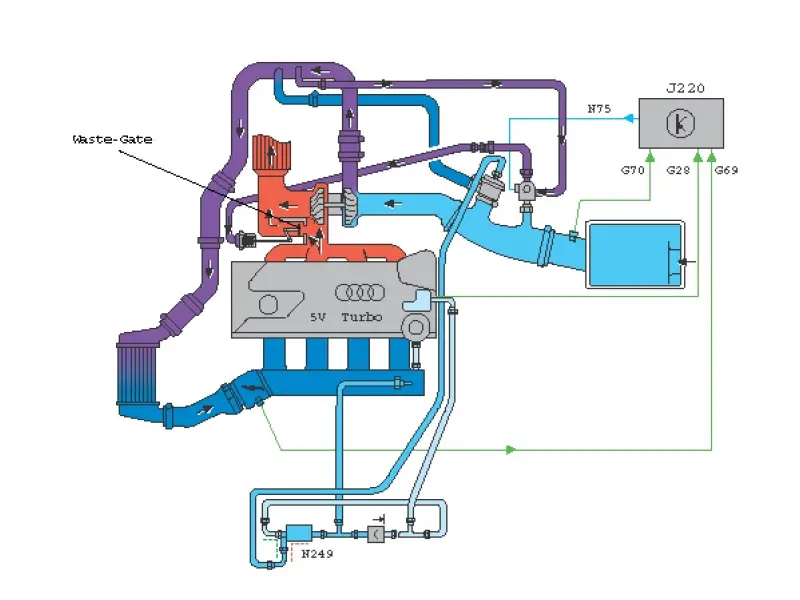
The boost pressure setpoint is calculated by the J220 engine management electronics, depending on the engine torque demand. This electronics manages the height of the boost pressure, acting on the opening time of the solenoid valve N75, responsible for limiting the boost pressure. For this management, a control pressure is generated, composed of the boost pressure in the turbo (purple), and the atmospheric pressure (light blue). This control pressure is exerted against the spring in the turbo control valve, and in this way opens or closes the so-called “Waste-Gate” valve of the turbocharger.
In its off state, the N75 solenoid valve is closed, and the turbo pressure is exerted directly on the control valve. In this configuration, the latter opens in the presence of a low overpressure. In case of failure of the regulation, it is thus possible to limit the maximum pressure of supercharging to a basic value (mechanical supercharging pressure).
In case of closing of this by-pass which is the Waste-Gate, the pressure of supercharging increases. At low revs, the turbocharger can thus provide a boost or a large amount of air, necessary to obtain a high torque.
As soon as the boost pressure reaches the calculated value, the bypass is opened and a certain amount of exhaust gas bypasses the turbine. The turbocharger speed decreases, and as a result the boost pressure.
Turbocharging on the 225 hp engine
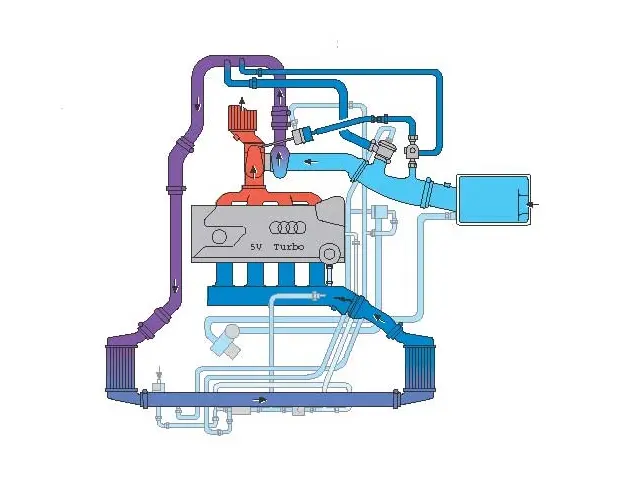
To increase the power and torque of the 1.8L 5V engine to 165 kW, a number of modifications were required compared to the 132 kW base engine.
One of the important specifications is the need for more fresh air. To achieve this, the diameters of the suction system and turbocharger had to be increased.
The larger amount of air delivered by the turbo could no longer be efficiently cooled by the air exchanger. To increase efficiency, a second air exchanger was installed on the left side of the vehicle, in series with the first.
Turbocharger air recirculation circuit
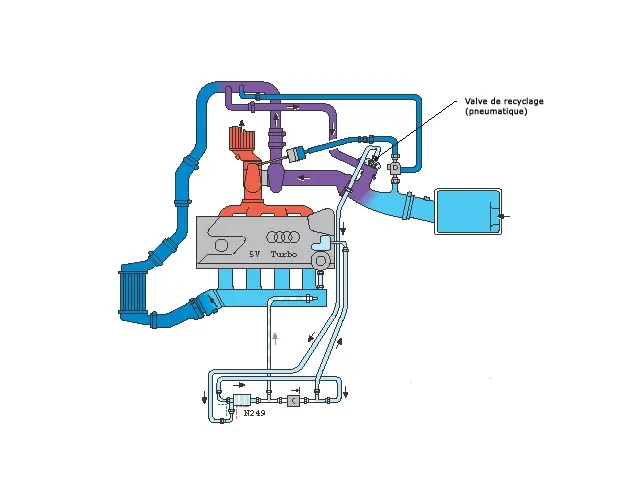
When the air intake butterfly closes (accelerator is released), while the boost pressure is still present, there is a back pressure in the boost circuit. The turbine is heavily braked.
When the throttle is re-opened, the turbocharger should be revved up again. The supercharging recycling system makes it possible to avoid this “turbo hole”. The supercharging recycling valve is mechanically operated and pneumatically controlled. It consists of a membrane and a spring. It is in principle controlled by the electronic management of the Motronic 7.5 engine, through an air valve for N249 turbochargers.
Together with a vacuum air tank, we obtain an operation of the N249 independent of the air pressure of the suction circuit. In case of failure of the valve N249, the management is done through the depression of the engine, taken immediately downstream of the throttle.
As soon as the throttle closes, the recirculation valve bypasses the boost circuit. Vacuum acts against the valve spring, opening the valve and connecting the intake and boost circuits. The turbine is not slowed down. When the throttle is opened again, pressure in the intake circuit drops. The spring closes the recirculation valve, and maximum turbine speed is available.